Bolgoda is the largest freshwater wetland in Sri Lanka, featuring two interconnected lakes. It is located on the southern boundary of the Colombo District and extends into the Kalutara District. Bolgoda Lake was listed in "1001 Natural Wonders of the World: You Must See Before You Die," published in 2017 by Michael Bright (Ed.), due to its ecological, social, and economic significance.
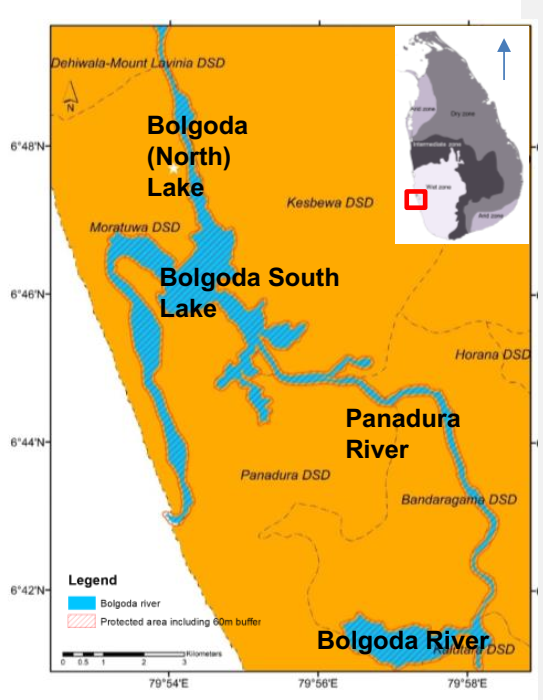
The “Bolgoda North Lake” is located on the south-west boundary of the Colombo District. A relatively smaller “Bolgoda South Lake” in the northwest of Kalutara District and the “Bolgoda River” that meets the ocean from Panadura are the two other components of the Bolgoda ecosystem with 13 islands.
The footprint of the above is approximately 12.45 km2 (1245 ha) and situated between longitudes E. 790 55’-790 58’and latitudes N 60 40’ – 60 48’ and extends through six Divisional Secretariat Divisions [DSD’s] of Ratmalana, Kesbewa, Moratuwa in the Colombo District and Panadura, Bandaragama and Kalutara in the Kalutara District adjoining up to 24 Grama Niladari Divisions [GND’s] in the context of administrative zones.
In addition to the Bolgoda Lakes, the Boloda Basin consists of five other lakes namely; Boralesgamuwa, Gamanpila, Kesbewa, Uyanwatta, Walgama; the Lunawa Lagoon and Bellanvila-Attidiya Marsh. The “Weras Ganga” that travels through a major garbage dumpsite and an industrial zone delivers the main source of water to the Bolgoda North Lake in addition to the rain and runoffs. Further, it receives water from two small streams named the Panape Ela and Rambana Ela which drains water from Maha Oya. Further associations of the Bolgoda hydrological system can be identified as Kelani River through the Bolgoda Canal & Kirulapone Canal as well as Kepu Ela which connects to the Kalu Ganga.
These interconnected water bodies and streams form a complex hydrological system, crucial for the ecological balance of the Bolgoda region.
The Bolgoda ecosystem boasts rich biodiversity in terms of fauna and flora. It offers various benefits, including irrigation, fisheries, recreation, flood control, sink services for industry, and habitat preservation. However, complex land use patterns associated with the Bolgoda ecosystem have led to encroachments, illegal landfilling and unauthorized constructions, unregulated tourism and watersports, illegal prawn cultivation, sand mining, and the dumping of domestic and industrial wastes and effluents.
Protective, preventive, and rectification measures are needed to minimize the damage to this valuable ecosystem and ensure its long-term sustainability for both the ecosystem itself and the associated communities, in line with the Sustainable Development Goals by United Nations.